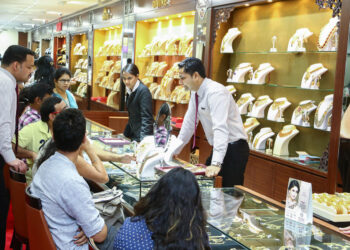


The India-UAE Gems & Jewellery Dialogue – Boosting Confidence took place on 2 April 2026 at the Taj Business Bay in Dubai, gathering over 200 industry stakeholders to discuss the future of bilateral trade.
Organised under the patronage of the Embassy of India in the UAE, the Consulate General of India in Dubai, and the Gem & Jewellery Export Promotion Council (GJEPC), the high-level meeting focused on maintaining market resilience amid shifting global economic conditions.


Manufacturers, wholesalers, and policymakers from both nations attended to reinforce trade ties and evaluate new opportunities under existing framework agreements.
Strategic Integration Under CEPA
According to a report by GJEPC, the keynote address was delivered by H.E. Dr. Deepak Mittal, the Ambassador of India to the UAE. Dr. Mittal reaffirmed the Indian government’s commitment to the sector, highlighting the strategic significance of the UAE as a core partner within the India-UAE Comprehensive Economic Partnership Agreement (CEPA).
The dialogue served as a platform for dignitaries, including H.E. Mohammed Ali Rashed Lootah, President of the Dubai Chamber, and H.E. Ahmed Al Khaja, CEO of the Department of Economy & Tourism, to discuss expanding the integration of Indian manufacturing capabilities with the UAE’s established retail ecosystem.
The Consul General of India in Dubai, Satish Kumar Sivan, noted the necessity for industry unity to sustain trade confidence. Sabyasachi Ray, Executive Director of GJEPC, further outlined the council’s strategy to deepen engagement across the Gulf Cooperation Council (GCC) through targeted collaborative initiatives.
A primary focus of the discussion was the role of the India Jewellery Exposition Centre (IJEX), which serves as a year-round B2B platform in Dubai for Indian micro, small, and medium enterprises (MSMEs) to access regional markets.
Growth Trends in the Bilateral Jewellery Sector
The dialogue follows a period of significant growth in the gems and jewellery trade between the two countries. Research from the Press Information Bureau indicates that bilateral trade between India and the UAE surpassed USD 100 billion in the 2024-25 financial year, largely driven by the benefits afforded by the CEPA.
The agreement has specifically facilitated duty-concessional gold imports and provided Indian exporters with preferential market access, allowing the sector to account for approximately 30 per cent of India’s total exports to the region.
Further data from the GJEPC H1 FY2025-26 report reveals that gold jewellery has been a primary driver of export growth, with plain gold jewellery exports increasing by 46.74 per cent year-on-year during the first half of the financial year.
This surge is attributed to the 1 per cent tariff concession on gold bars imported from the UAE under the CEPA quota system.
Infrastructure and Regulatory Support
To further support this trade volume, the IJEX facility in Dubai’s Gold Souq continues to serve as an access point for Indian artisans and manufacturers.
As noted by the UAE Ministry of Economy, the centre was established to enable Indian MSMEs to showcase their products and secure orders from international buyers throughout the year. The facility allows members to establish a consistent presence in Dubai without the need for independent local offices.
Additionally, the regulatory environment has been clarified through the introduction of the Customs Baggage Regulations 2026. These rules, which became effective in February 2026, provide specific duty-free allowances for Indian residents returning with jewellery from Dubai, as highlighted by Angel One.
Such measures are expected to bolster consumer confidence and retail sales within the bilateral corridor as stakeholders look toward expanded non-oil trade targets by 2030.