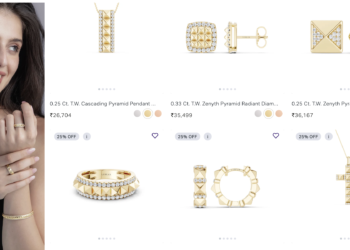


The Government of India has eliminated the ₹10 lakh value ceiling for shipments via courier mode, effective 1 April 2026. This regulatory change follows through on provisions outlined in the Union Budget 2026 to facilitate e-commerce exports and improve cross-border trade efficiency.
The abolition of the cap allows registered courier services to handle shipments of unrestricted value, assisting the movement of high-value goods such as diamonds and fine jewellery in international markets.


According to the GJEPC, the Central Board of Indirect Taxes and Customs (CBIC) issued Circular No. 17/2026 and Notification No. 08/2026-Customs to operationalise these reforms.
The new framework introduces simplified procedures for handling returned and rejected shipments, specifically focusing on the e-commerce sector.
A dedicated “Return Module” has been integrated into the Express Cargo Clearance System (ECCS) to expedite the processing of these consignments, reducing the administrative burden on domestic manufacturers.
GJEPC Advocates for Inclusive Risk-Based Norms
Kirit Bhansali, Chairman of the Gem & Jewellery Export Promotion Council (GJEPC), described the removal of the value cap as a landmark decision for the industry.
He stated that the move allows exporters to ship high-value items to global customers without being hindered by previous administrative value restrictions. However, the council expressed concerns regarding the current exclusion of jewellery from the new risk-based approach for re-imports.
Under the updated guidelines, while most courier re-imports will benefit from risk-based verification instead of traditional stringent physical checks, precious and imitation jewellery exported via e-commerce remain subject to older, more rigorous protocols.
Bhansali urged the government to extend the risk-based treatment to the entire industry to ensure a level playing field for Indian businesses. The council has maintained that such parity is essential for maintaining global competitiveness as consumer buying habits shift toward digital platforms.
Streamlining Logistics and Returns Management
The reforms also address the accumulation of uncleared or unclaimed imports at international courier terminals. New provisions for “Return to Origin” (RTO) allow for the re-export of goods lying at terminals beyond 15 days, provided they are not under investigation or restricted.
This measure is expected to reduce logistics congestion at major hubs and lower the operational costs associated with rejected global orders.
Amendments have been notified to the Courier Imports and Exports (Electronic Declaration and Processing) Regulations, 2010, and the Courier Imports and Exports (Clearance) Regulations, 1998.
These legal adjustments formalise the removal of value-based restrictions that previously complicated the export of high-ticket items. Data from the Central Board of Indirect Taxes and Customs indicates that these digitisation efforts are part of a broader strategy to support the national e-commerce export ecosystem.
Strategic Growth in E-Commerce Exports
The Indian jewellery sector has been a primary advocate for these changes as it seeks to increase its share of the global digital retail market.
Historically, India’s jewellery exports have been dominated by bulk B2B shipments, but the rise of online marketplaces has created a demand for direct-to-consumer delivery. According to the Directorate General of Foreign Trade, simplifying the return process and removing export barriers are vital steps for India to reach its long-term merchandise export targets.
Industry analysts indicate that the previous lack of simplified return norms was a significant barrier for Indian jewellers competing with international brands. In previous sessions, the GJEPC highlighted that the complexity of handling returns often discouraged smaller enterprises from exploring international markets.
With the implementation of the new digitised modules and the removal of value caps, the government intends to establish India as a competitive global hub for high-value jewellery exports via courier channels.